What Happens During Removal
| What happens |
What it means for you |
| The work area gets sealed in plastic and put under negative pressure |
Spores stay in the room we’re working in instead of riding the AC into the bedrooms |
| Drywall, insulation, carpet pad, ceiling tile, and trim that got wet and moldy come out; studs, joists, slab, and masonry get cleaned where they stand |
What can’t be saved leaves; the structure that can be saved stays |
| Everything removed is bagged inside the containment before it moves an inch |
No open bags of wet drywall going down your hallway |
| Cleaned surfaces get HEPA-vacuumed and wiped, and the framing dries before rebuild |
Nobody hangs new sheetrock over damp wood |
| We find where the water got in and tell you what has to change for the work to hold |
Removal with the leak still running would just be a second job |
| You get a written report of what came out, from where, and why |
It’s yours to keep, and a buyer or an adjuster will ask to see it |
After The Storm
Gulfport has been the target more than once. Camille came ashore at the Hancock–Harrison line in 1969. Katrina in 2005 pushed the highest storm surge on record in the United States onto this coast — NOAA put it near 27.8 feet at Pass Christian — and the water ran up through Long Beach, West Gulfport, Bayou View, and downtown. Zeta in 2020 was smaller and still peeled roofs from Orange Grove to Diamondhead. Between the named storms there’s the ordinary summer: a tropical downpour finding a bad flashing, a week of rain on a tarped roof, a gutter dumping against the foundation.
A storm’s water leaves in a day. The drywall, insulation, and subfloor it touched take much longer, and CDC says material wet for more than 48 hours can already support extensive growth. A wall that got wet on the outside during a storm often stays wet on the inside after the siding dries. If you’re still drying out, or you dried out months ago and one room has smelled off ever since, that’s worth a call.
One more thing while the cleanup is happening: EPA, CDC, and FEMA all say to keep kids away from mold cleanup work. Let them stay at grandma’s for the day.
Slab, Piers, Or Stilts — It Doesn’t Matter To Mold
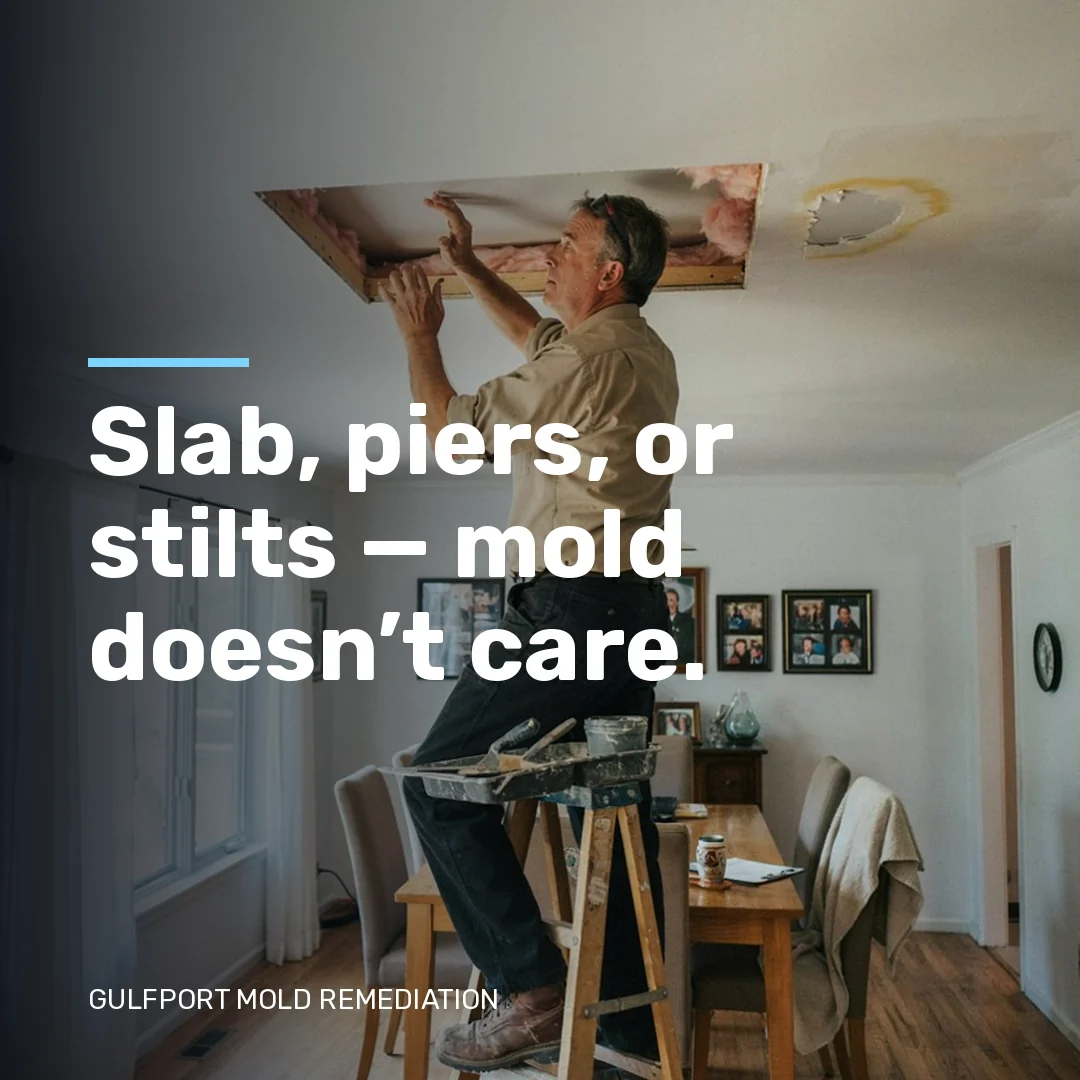
The coast rebuilt fast after 2005, and it rebuilt two ways. Along Beach Boulevard from Pass Christian through Long Beach to Gulfport, much of what stands now is up on piers or pilings, with an open space underneath that Gulf air moves through all summer, condensing on cold pipes and duct. Inland — Bayou View, Orange Grove, Lyman, the subdivisions off I-10 and Highway 49 — it’s mostly slab houses, some 1960s and 70s ranches, a lot of them built or gutted and redone in the years right after the storm. A raised coastal house can hold damp air underneath the same way a crawl space does. A slab house holds it in the wall cavities and the attic instead.
Old house or new, high or low, the wet material has to come out and the framing has to be cleaned. That part of the job doesn’t change with the foundation.
Small Area. Smart Time To Act.
The patch on the bathroom ceiling that you could cover with a dinner plate is the easy version of this job. EPA’s line for calling a professional is about ten square feet — roughly a three-by-three area — and anything on drywall or insulation is a removal job at any size, because the growth is in the material, not just on it. What you can see today is often the edge of the wet area, not the middle.
Scrubbing it doesn’t settle it. EPA doesn’t recommend bleach as a routine practice for mold, and it says never to paint or caulk over it. A weekend with a sponge wets the surface again, the paper facing stays damp, and the stain returns in the same spot with the same water behind it. Dead mold is still an allergen, so killing it was never the goal. Getting it out of the house is. Don’t wait for “bad enough.” Call while it’s still a patch you can point to.
Opening A House That Sat Closed All Summer?
Gulfport has a lot of houses that don’t get lived in every week. A place near the beach that the family uses on holidays. A house that sat shut while someone was deployed out of Keesler or the Seabee base. A parent’s house in Bayou View that’s been closed up since spring. A house that sat closed through a Gulf Coast summer with the air off, or set to eighty-five, holds moisture the way a boat cabin does. EPA says to keep indoor humidity under 60 percent, ideally 30 to 50; a shut-up house in August won’t get near that on its own.
If you walked in and got a wall of smell, found a film on the furniture, or saw spots on a ceiling or in a closet, call and tell us what you found. The house didn’t need a leak to get here, and it doesn’t need a bigger problem before you act.
Selling The House?
Buyers on this coast ask about water. They ask about 2005, they ask about the roof, and they ask why one closet smells like a wet box. A removed problem with a written report in the folder is a short conversation; a stain the buyer’s agent finds during a walk-through is a long one. If you’re listing this season, or you’re already under contract, say so when you call. It changes what we photograph and what we put in the report.
Call And Tell Us What You See
We answer at any hour. Describe what you’re seeing or smelling, where it is, what got wet, and when the water started. If we’re available you’ll be connected right away; if we’re on a job you’ll get a scheduled callback, and we’ll tell you which number to watch for.
We take calls from Gulfport, West Gulfport, Bayou View, Orange Grove, Lyman, Long Beach, Pass Christian, DeLisle, Bay St. Louis, Waveland, Diamondhead, and Kiln. The full list is on the areas page.
See growth on drywall, ceilings, or trim? Call.